

The Resilient Writer/Artist
Why Every Great Manuscript is Built on the Ruins of a First Draft


Responding to Amie's excellent article. A counter viewpoint.
The romantic image of the solitary artist, sequestered in a candlelit room and protecting a fragile masterpiece from the harsh light of public opinion, is a persistent myth that does more to stifle creative potential than to protect it. While it is true that unsolicited or poorly delivered feedback can sting, the growing movement to treat creative work as a delicate “soul-baby” that must be shielded from the world until it is fully formed is a strategic error. To argue that feedback ruins creativity is to misunderstand the fundamental nature of the creative act itself, which is not merely an act of internal expression, but an act of communication. If Art is meant to be seen, heard, or felt by anyone other than the creator, then the perspective of the “other” is not a secondary intrusion; it is a primary component of the work’s completion. By framing feedback as a lethal threat to the artist’s spirit, we encourage a culture of fragility that prioritizes the artist’s ego over the quality of the Art. True creative mastery is not found in avoiding criticism, but in the rigorous, often painful process of incorporating external perspectives to bridge the gap between what an artist intended and what they actually achieved.
The assertion that most feedback “sucks” because people lack the skill to deliver it assumes that the only valuable feedback is professional, sanitized, and constructive. In reality, the most visceral and honest reactions often come from those who are not “qualified” in the traditional sense. When a neighbor, a friend, or a random reader says they are bored or confused, they are providing a raw data point that no amount of technical expertise can replicate. The artist who dismisses this because the person “doesn’t understand the genre” is often just finding a sophisticated way to ignore a failure in their own communication. If a story is boring to a non-expert, it might just be boring. If a painting fails to evoke emotion in a layperson, it might lack the universal resonance the artist intended. Waiting until a project is 100% complete before testing these waters risks spending years building a house on a foundation of sand. Early feedback, even in its most unrefined form, acts as a necessary stress test. It is far better to have a premise dismantled when it is only thirty percent finished than to realize after three years of labor that the core of the work is hollow.
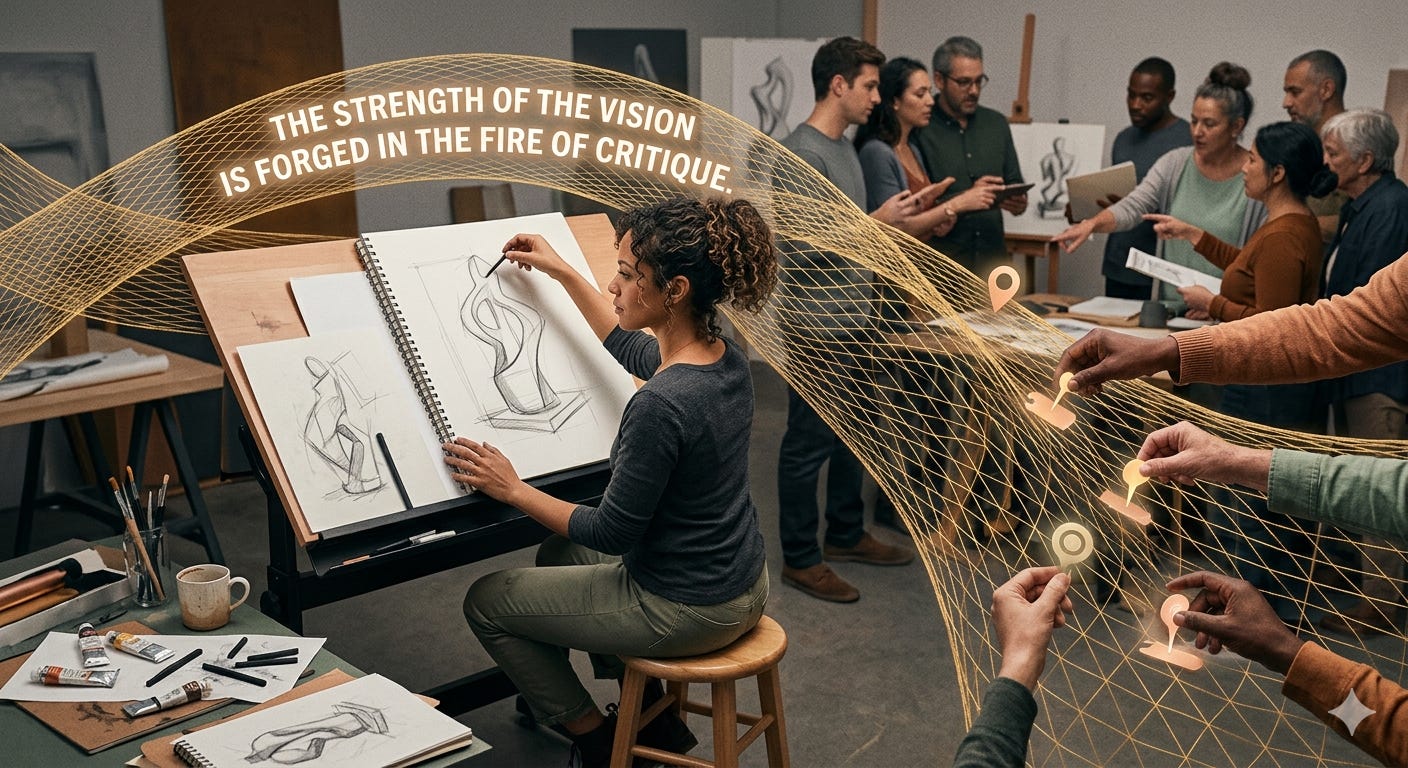
Furthermore, the idea that early-stage Art is too vulnerable to share overlooks creative friction as a catalyst for growth. Resistance is a requirement for strength, both in the physical and intellectual worlds. When an artist is forced to defend their choices or explain their vision in response to a critique, they are forced to understand their own work more deeply. They must decide which elements are non-negotiable and which are simply the result of habit or laziness. This internal debate, sparked by external pressure, is where the artist's voice is forged. Without the friction of outside opinion, an artist is likely to drift into self-indulgence, repeating the same patterns and leaning into the same tropes because no one is there to tell them they are talking to themselves. Feedback prevents the echo chamber of the self. It forces the creator to step outside their own head and view the work through a lens they are incapable of providing for themselves.
The psychological toll of receiving feedback is often cited as a reason to avoid it, with critics described as “lean” or “obliterating.” However, professionalizing one’s relationship with their work requires a separation of the self from the object. If a writer feels that a critique of their manuscript is a critique of their soul, the problem is not the feedback; the problem is an unhealthy attachment to the work. Treating Art as a sacred extension of the self makes it impossible to edit with the necessary ruthlessness required for excellence. A creative professional should be able to view their work as a mechanic views an engine—looking for what is broken, what is inefficient, and what can be tuned. By inviting feedback early and often, an artist builds the emotional callouses necessary to survive in a world where the public will eventually be much crueler than a teacher or a peer. Resilience is not built by avoiding discomfort, but by engaging with it until it no longer has the power to stop the creative process.
There is also the danger of the “late-stage reveal.” When an artist works in total isolation for years, the stakes for the final unveiling become paralyzingly high. The pressure to produce a masterpiece after such long seclusion can lead to chronic perfectionism and an inability ever actually to finish the work. Conversely, those who share their work in stages—seeking input, pivoting, and refining as they go—demystify the process. They treat the work as a living, evolving thing rather than a static monument. This iterative approach is the backbone of almost every successful industry, from software development to architecture, and there is no reason why Art should be exempt. Feedback provides a series of “check-ins” that provide momentum. It offers the artist small victories and necessary course corrections that keep the project moving forward.
When we tell young artists that feedback is a “powerful and dangerous thing,” we instill a fear that can be more paralyzing than any bad review. We should instead teach them that feedback is a buffet, not a mandate. The artist remains the ultimate authority, sitting on the “throne” of their own creation, but a wise ruler listens to their advisors. To dismiss feedback because it might be “mean” or “unskilled” is a form of intellectual cowardice. It assumes that the artist’s vision is so weak that it cannot survive a dissenting opinion. On the contrary, the strongest ideas are those that have been dragged through the mud of public opinion and come out the other side cleaner and sharper.
The most dangerous narrative in the creative world is that the artist’s intuition is infallible. While intuition is the starting point, it is rarely the finish line. We are all prone to blind spots, clichés, and logical fallacies. We get too close to our work to see the obvious flaws. Feedback is the only mirror we have that shows us the back of our own heads. To reject it is to choose to walk through the world with a distorted view of one’s own capabilities. Indeed, you shouldn’t listen to everyone, but you must be willing to hear everyone. The skill of the artist lies in the discernment—the ability to sift through the “sucking” feedback to find the one sentence that rings true, the one observation that points toward a better version of the work.
Ultimately, creativity is not ruined by feedback; the fear of it ruins it. The “lethal” quality attributed to criticism only exists if the artist gives it the power to be a terminal judgment rather than a diagnostic tool. When we stop viewing feedback as an attack on our identity and start viewing it as free labor—as someone else taking the time to engage with our thoughts—the entire dynamic shifts. We should seek out the critics who make us uncomfortable, because those are the people pushing us past our current boundaries. The artist who only seeks “safe” feedback or praise has stopped growing. They have chosen the comfort of the womb over the vitality of the world.
In the end, the goal of any creative endeavor should be to produce the best possible version of the work, not to protect the ego of the person who made it. If the work is improved by a “mean” comment from an “unqualified” neighbor, then the feedback was successful. The history of Art is a history of collaboration, influence, and reaction. No great work was ever truly created in a vacuum. By embracing feedback—the good, the bad, and the unskilled—we uphold a tradition of excellence that values the final product over the creator's temporary comfort. We should stop telling artists to hide their “babies” and start telling them to let their work grow up, leave the house, and learn how to take a hit. That is the only way it will ever be strong enough to matter.
In a world saturated with content, the barrier to entry is no longer the ability to create, but the ability to refine. Anyone can produce a first draft or a rough sketch in isolation. The real work—the creative work—is in the editing, the shifting of perspective, and the relentless pursuit of clarity. Feedback is the fuel for that process. It provides the external gravity that keeps an artist’s ideas from drifting off into meaningless abstraction. While it may be true that “most feedback sucks,” it is equally true that most first drafts suck even more. The bridge between a poor first draft and a brilliant final piece is almost always built with the help of others. To burn that bridge in the name of “protecting creativity” is a self-defeating act that ensures the artist will never reach the heights they are truly capable of achieving. True creativity is not a fragile flower that withers under a harsh word; it is a fire that uses everything—including criticism—as fuel to burn brighter.
Author’s Note: “Independent writing is fueled by its readers. By becoming a paid subscriber, you’re directly investing in the future of this space and ensuring I can keep creating.”
©2026 The Street Writer.